
A spotlight’s beam angle is one of its most important characteristics, yet often one of the most commonly overlooked.
In short, a light bulb’s beam angle denotes how wide its light spreads. It is measured in degrees, and the bigger the number, the wider the beam of light.
Different beam angles are better for certain uses. For example, a retailer might need a spotlight with a very narrow, focused beam in order to show off products on a shop-floor display. A spotlight with a beam angle of 15-20° would be ideal in this instance.
Such a narrow beam would be no good, however, for someone who just wanted to light their kitchen. It would be highlight specific areas, such as the sink or a certain counter-top, very well, but it would leave much of the room in the dark. In this case, a spotlight with a much wider beam would be more suitable.
This can sometimes be hard to visualise without examples, so use our interactive switches below to see how spotlights with different beam angles illuminate a room.
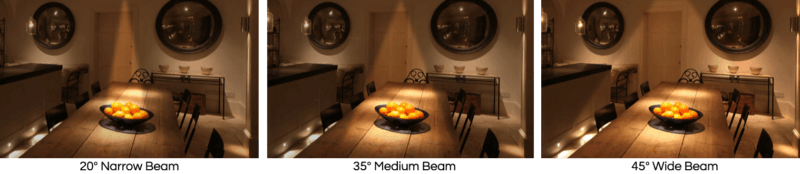
You can find spotlights with beam angles anywhere between 15-110°. If you’re looking for light bulbs just to use for general lighting purposes, those at the higher end of the scale are ideal.
You may also find other types of light bulbs and fittings that specify a beam angle. Anything that is referred to as a directional light source (a lamp emits light in a specific direction, rather than all directions) should be labelled with its beam angle. Fluorescent tubes, surface mounted bulkheads and integrated downlights all fall into this category.
The principle is exactly the same in all these cases; the bigger the beam angle, the wider the light spread.
You can read more about LED Spotlights in our article LED Spotlights – All You Need to Know
Related Posts:
 Beam Angles ExplainedWhen it comes to selecting which beam angle you need there are certain things you need to consider: How far apart are...
 Replacing Halogen MR16 spotlight bulbs with LED MR16 light bulbs – Make the SwitchIf you’ve still to upgrade your halogen MR16 spotlights to LED MR16, time is running out. In September 2016, the European Commission...
Hi there 👋.
I have a wall hanging on a pole with brackets. I’ve applied very small jewels to the hanging and would like these highlighted but I’ve
no idea what sort of spotlight ( or possibly other lighting ) would be suitable…The beauty of the gold ( not real gold 🤭) thread and jewels really isn’t being met…the artist in me isn’t happy 😔 I can send photos if it will help you to help me ☺️ Thanks, Bernadette
Hi Bernadette, please send photos through to our customer service enquiries@Lightbulbs Direct.com and we can see if have a suitable product. Out of interest, I assume you only want the jewels lighting and not the wall?
Is there a GU10 Bulb with a narrow angle like 5° available to buy? Or a trick to create such narrrow angle?
Not seen a 5° ourselves, but we did used to sell a 10° but we have nothing like that at the moment. Search google for “Narrow Beam GU10” and you mind find alternatives.
I need a spotlight for out doors that will provide a beam width of about 8′, from 30′ feet away. Suggestions?
Hi Pat, no, we have nothing suitable for that application – try and give google a go, trying searching for “narrow beam floodlight”.
what is the best bulb to use for artist indoors
Hi Susan, you will need a bulb that has a high colour rendering index (CRi) – these bulbs reproduce colours in the most natural way and try to represent how the colour would appear if lit by the sun. You could try Crompton Lamps Craftlight GLS or a Philips LED GU10 High CRi